Common Casting Alloys: A Deep Dive into Gray Iron vs. Ductile Iron vs. Steel

Best Practices for Designing Cast Parts for Manufacturing part I
2026-03-30In the world of industrial manufacturing, choosing the right material is paramount. When it comes to cast components, three alloys often stand at the forefront: Gray Iron, Ductile Iron, and Cast Steel. While they all begin as molten metal poured into a mold, their distinct microstructures give them unique mechanical properties, making them suitable for vastly different applications.
Understanding these differences is key to optimizing performance, durability, and cost-effectiveness for your project. Let’s cast a critical eye over each.
1. Gray Iron: The Workhorse of Casting
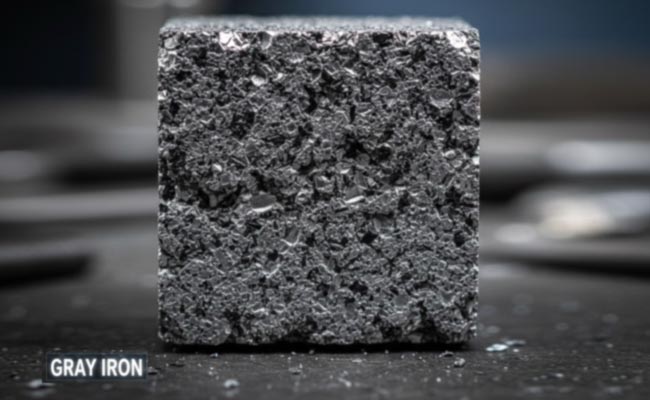
Microstructure: The defining characteristic of Gray Iron is its graphite content, which solidifies into flake-like structures within the iron matrix. These graphite flakes are what give Gray Iron its name and its distinctive fracture appearance.
Properties:
Excellent Damping Capacity: The graphite flakes absorb vibrational energy, making Gray Iron ideal for machine bases and engine blocks where noise and vibration reduction are critical.
Good Machinability: The graphite acts as a natural chip breaker and lubricant during machining, reducing tool wear and improving surface finish.
High Thermal Conductivity: Efficiently dissipates heat, a beneficial trait for brake drums and manifolds.
Low Tensile Strength & Brittleness: The graphite flakes create stress concentration points, leading to a relatively low tensile strength and making it brittle under tension.
Good Compressive Strength: While weak in tension, it performs well under compression.
Cost-Effective: Generally the most economical of the three to produce.
Common Applications: Engine blocks, cylinder heads, machine bases, counterweights, manhole covers, brake discs/drums.
2. Ductile Iron: The Best of Both Worlds
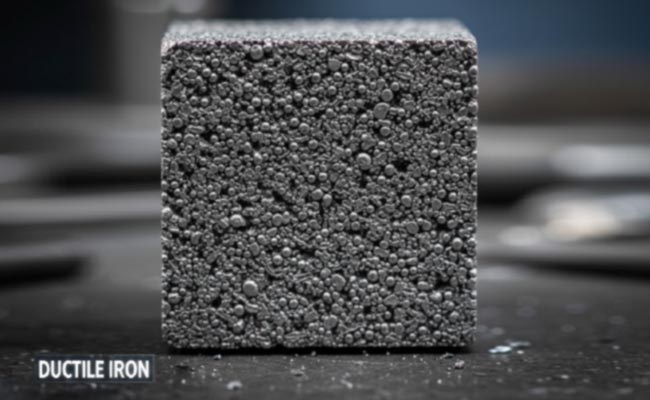
Microstructure: Ductile Iron is essentially Gray Iron with a twist. Through the addition of magnesium (or cerium) to the molten metal, the graphite forms into spheroidal (nodular) shapes rather than flakes. This crucial change in microstructure dramatically alters its mechanical properties.
Properties:
High Strength & Ductility: The spherical graphite nodules act less like stress concentrators, allowing the material to deform significantly before fracturing. This gives it “ductility” – the ability to bend without breaking.
Excellent Toughness: Can withstand impact and shock loads better than Gray Iron.
Good Wear Resistance: Especially when heat-treated.
Moderate Damping Capacity: Better than steel, but not as good as Gray Iron.
Good Machinability: Better than steel, but slightly less than Gray Iron.
Common Applications: Automotive suspension parts, heavy-duty truck components, valves and pump bodies, wind turbine hubs, crankshafts, gears. It often replaces steel forgings or weldments due to its casting versatility and cost advantages.