Digital Speed Meets Metallurgical Precision: The Perfect Symbiosis for Steel Casting

The Metallurgy of the Future: Our Internal Labs’ Research on High-Performance Steel Casting
2026-03-16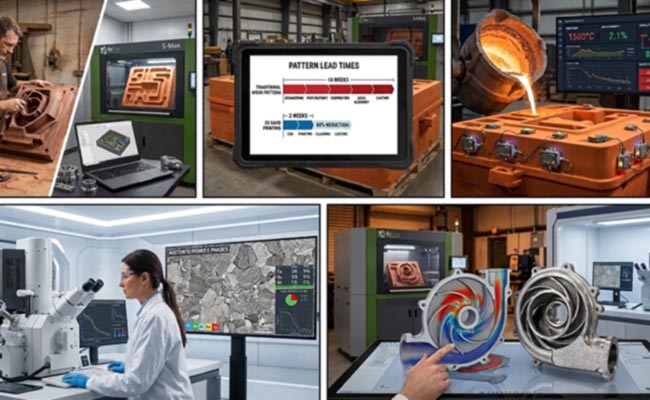
Historically, foundry manufacturing and metallurgical research operated in parallel but separate silos. 3D printing (3DSP) provided the digital geometry, while the metallurgy lab developed the alloys.
Today, we are bridging that gap. We recognize that 3D sand printing is not just a tool for saving time (though an 80% reduction is impressive); it is a powerful experimental platform that enables unprecedented precision in metallurgical engineering, especially for complex steel castings.
The Symbiotic Advantage
When the digital accuracy of 3DSP is unified with deep metallurgical understanding, new possibilities in steel casting design are unlocked.
1. Geometric Solidification Modeling: Because 3DSP molds are created digitally, our engineers can use the exact same CAD file to simulate the solidification process with incredible detail. By visualizing potential “hot spots” (where shrinkage may occur), they can redesign the mold’s internal features (like printed risers or chills) within the CAD file before printing. This guarantees that the metallurgy and the geometry work together for a defect-free casting on the first attempt.
2. Controlled Local Solidification (Printed Chills): In traditional molding, inserting metal “chills” (which quickly draw heat away) is a clumsy manual process. 3DSP allows engineers to print the chill geometry—such as delicate cooling fins or internal channels for air/water cooling—directly into the mold structure. This provides the first-ever tool to precisely dictate how different sections of the same complex steel casting will solidify, directly influencing the local grain structure and mechanical properties.
Redefining What is “Possible”
We are now utilizing 3DSP to cast geometries and complex multi-alloy compositions that were previously impossible.
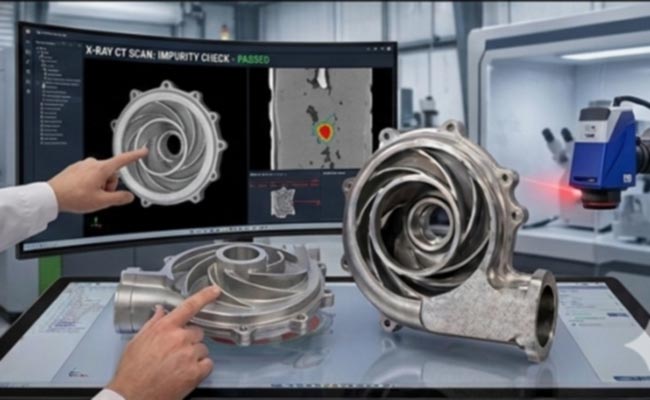
Consider a large, complex high-nickel steel casing that traditionally required days of manual core assembly (adding geometric risk) and complex feeding paths to manage the high shrink rate. Using 3DSP, we simplified this into a single printed mold/core, integrated printed chills into the core itself, and validated the solidification model with lab data. The resulting casting was produced in two weeks (down from months) and possessed superior microstructural uniformity and density.
By uniting digital speed and material insight, we are proving that the future of casting is not about a single technology, but about the integration of digital and physical sciences to redefine performance.