The Importance of Mold Design and Its Impact on Product Quality

Best Practices for Designing Cast Parts for Manufacturing part 2
2026-03-02
In modern manufacturing, mold design plays a pivotal role in determining both the efficiency of production and the quality of the final product. Whether in metal casting, plastic injection molding, or die casting, the precision and effectiveness of the mold are key factors that directly influence the outcome.
1. Dimensional Accuracy and Consistency
A well-designed mold ensures that each part produced meets exact dimensional specifications. Inaccurate mold cavities can result in misaligned features, warping, or undersized/oversized components, leading to rework or rejection. Precision in mold design guarantees repeatability and uniformity across high-volume production runs.
2. Surface Finish and Appearance
The texture, polish, and geometric design of the mold surface have a direct impact on the product’s aesthetic appeal. Poor mold design can lead to visible defects like weld lines, flow marks, or uneven surfaces. A good mold provides a smooth and consistent surface finish, minimizing the need for post-processing.
3. Structural Integrity of the Product
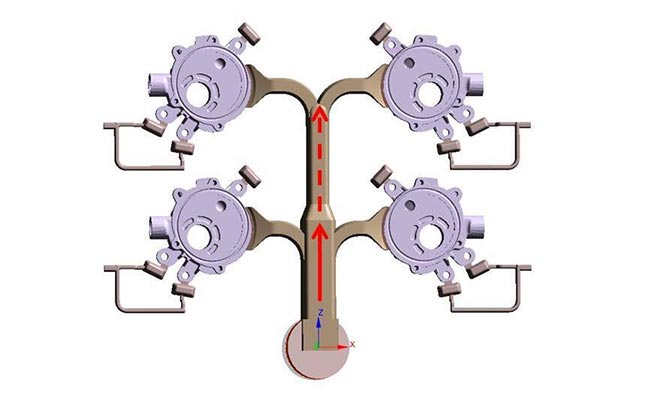
Mold design affects how the material flows and fills the cavity. Improper gate location, venting, or cooling channel placement can create air entrapment, shrinkage, or weak spots in the final product. Thoughtful mold engineering ensures that the product solidifies correctly, preserving its mechanical properties and structural strength.
4. Cycle Time and Production Efficiency
Efficient mold design optimizes the cooling and ejection systems, reducing cycle time and enhancing productivity. A poorly designed mold may cause delays, increase wear and tear on equipment, and lead to frequent stoppages or adjustments—affecting overall manufacturing efficiency and cost.
5. Waste Reduction and Cost Savings
An optimized mold reduces material waste, energy usage, and downtime. By preventing defects and ensuring first-time-right production, manufacturers save on raw materials, labor, and quality control expenses. This is especially important in high-volume industries where small inefficiencies scale quickly.
Conclusion
Mold design is not just a technical necessity—it is a strategic factor that determines the success of the manufacturing process. Investing in high-quality mold design results in better product performance, lower production costs, and higher customer satisfaction. In today’s competitive market, attention to mold design is essential for maintaining both quality and profitability.