The Metallurgy of the Future: Our Internal Labs’ Research on High-Performance Steel Casting

Protecting Workers in High-Temperature Environments
2026-03-09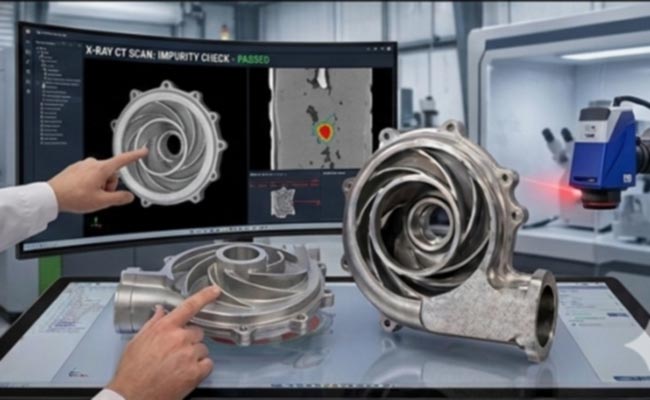
The performance of an industrial steel casting is not determined by its geometry, but by its micro-structure. The grain structure, chemical phase composition, and defect dispersion dictate whether a large turbine component will last twenty years or fail catastrophically in two.
In an industry where “commodity” materials are the norm, we have chosen a different path. We invest heavily in our internal Material Science and Metallurgy Lab. This is not a quality control lab; it is a dedicated R&D facility focused on pushing the boundary of what cast steel can do.
Visualizing the Unseen with Advanced Analysis
Our researchers use advanced tools to study steel at the microscopic and atomic levels. Our primary instruments include Scanning Electron Microscopy (SEM) and Energy Dispersive X-ray Spectroscopy (EDS). These tools allow our scientists to visualize:
Micro-grain structure and orientation.
Intergranular defect formation.
Phase composition and transformation temperature.
These detailed visualizations are critical. For instance, in our recent work with high-alloy duplex stainless steel, the traditional, standardized cooling models were insufficient. By visualizing the micro-structure during slow, managed solidification in our lab’s simulation ovens, we were able to develop proprietary heat treatment protocols that optimize both corrosion resistance and yield strength, well beyond industry standards.
Research with a Purpose
Our lab doesn’t just produce data; it produces performance advantages. The ultimate goal of our metallurgical research is to engineer “The Metallurgy of the Future”—creating materials specifically designed for the next generation of harsh environments.
Our current internal lab research focuses on several key areas:
High-Entropy Alloys (HEAs): Developing complex cast steel compositions with unparalleled strength-to-weight ratios and thermal stability.
Cryogenic Steel: Optimizing alloys for extreme low-temperature applications, vital for the growing LNG and aerospace sectors.
AI-Assisted Alloy Design: Utilizing computational metallurgy and ML algorithms to predict the properties of novel compositions before they are ever melted, drastically accelerating the pace of material development.
This internal R&D ensures that when a client requests a casting for a critical, next-generation application, we are not searching for a standard steel that might work; we are engineering the exact metallurgy the application demands.