Understanding Non-Destructive Testing (NDT): A Buyer’s Guide to Radiography and Magnetic Particle Inspection part I

Why ISO 9001 isn’t Enough: Understanding AS9100 and IRIS for the Rail Industry
2026-11-16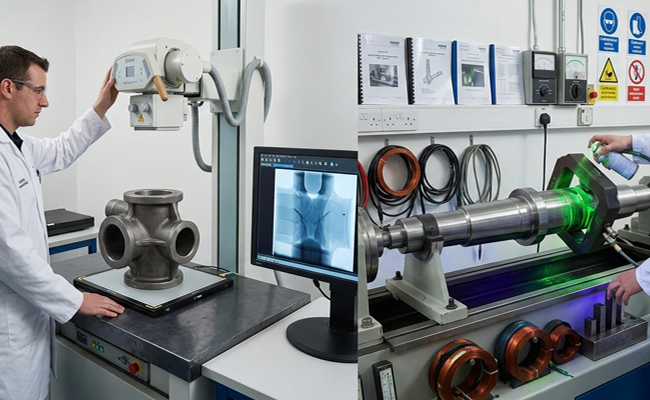
If you are a procurement manager, project engineer, or quality buyer, I know how NDT looks on a quote. It’s often a line item—RT Inspection (Weld 1-40) or MPI (Critical Shafts)—that seems expensive and hard to justify. You are paying to prove that nothing is wrong, which feels counterintuitive.
In my years as an NDT specialist, I’ve realized that the biggest bottleneck isn’t the science; it’s communication. Buyers need to understand what they are purchasing. You aren’t just paying for equipment and technician hours; you are buying documented confidence in your material integrity.
When you invest in Non-Destructive Testing (NDT), you are mitigating risk. You are ensuring a safety-critical part doesn’t fail in service, causing catastrophic loss or a PR nightmare. This guide is designed to help you, the buyer, understand two of the most powerful and common NDT tools, so you know exactly what you are getting and why it matters.
1. Radiographic Testing (RT) – “The Industrial X-Ray”
What It Is: This is the most intuitive method. Much like a medical X-ray, industrial radiography uses high-energy radiation (X-rays or Gamma rays) to penetrate a solid component. The radiation that passes through is captured on a detector (film or a digital sensor, as shown in the image). Denser areas, like solid steel, block more radiation, while less dense areas, like internal voids (porosity) or cracks, allow more radiation through, creating dark indications on the image.
What You, the Buyer, Must Know:
Best For: Finding internal, volumetric defects. Think subsurface cracks, gas pockets, slag inclusions, or incomplete fusion inside a heavy weldment or casting.
The Cost Drivers: High equipment costs (X-ray tubes or isotopic sources) and significant safety requirements (lead-lined rooms, exclusion zones). Digital RT (as visualized in our image) provides faster results and easier digital storage but requires a higher upfront investment in technology.
Key Consideration: RT is orientation sensitive. A tight, planar crack (like a delamination) that is perpendicular to the radiation beam may not appear on the final image. This is why multi-angle shots or alternative methods (like UT) are sometimes required. You are paying for a permanent record of internal integrity.