Why ISO 9001 isn’t Enough: Understanding AS9100 and IRIS for the Rail Industry

Managing Pattern Lifecycle Costs: Repair, Storage, and Replacement Strategies.
2026-11-09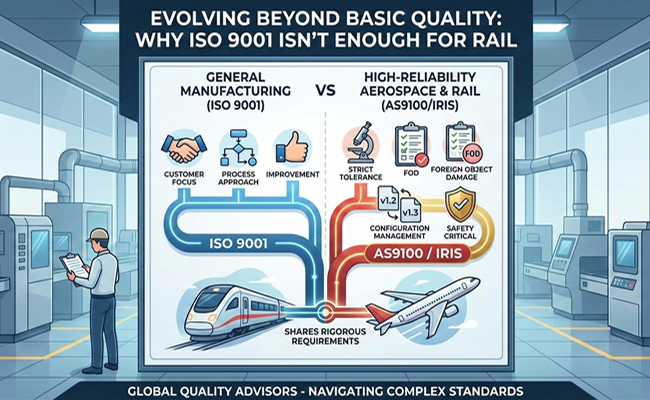
I’ve spent most of my career helping manufacturers navigate the labyrinth of quality management systems (QMS). When a new client in the heavy industrial sector tells me, “We already have ISO 9001, so we are set for anything,” my response is always the same: ISO 9001 is the foundation, not the finished structure.
This is especially critical when we talk about high-reliability, safety-critical sectors like the rail industry. While ISO 9001:2015 is a phenomenal horizontal standard (meaning it applies to any industry, from coffee shops to widget makers), it is not sufficient for the unique risk landscape of moving people and hazardous materials at high speeds.
For the rail sector, you need a standard that understands complexity. You need reliability that goes beyond “customer satisfaction” and addresses “public safety.” This is where industry-specific standards—specifically AS9100 (traditionally aerospace) and IRIS (International Railway Industry Standard)—become non-negotiable.
The Fundamental Shift: From Process to Reliability
The core difference I emphasize is the shift from process conformity to product safety and reliability. ISO 9001 focuses heavily on how you manage processes to meet customer requirements. AS9100 (which many advanced rail suppliers adopt because it mirrors the rigor required) and IRIS build directly on top of ISO 9001, but they introduce zero-defect mentalities and mandatory safety integrations.
When I review a standard ISO 9001 system, I’m looking at document control and management review. When I audit against IRIS or AS9100 for a rail client, I am diving deep into areas that ISO 9001 barely skims:
Safety-Critical Items Management: ISO 9001 asks you to identify key processes. IRIS/AS9100 require a robust process to identify Safety Critical Items (SCIs). These parts have a designated lifecycle where every characteristic is tracked, verified, and validated with extreme rigor. If a critical brake component fails, we must know exactly why and where it came from. Basic ISO 9001 cannot guarantee that level of granularity.
Configuration Management (CM): This is often the biggest hurdle for ISO 9001 shops moving into high-reliability manufacturing. CM isn’t just document control; it’s the formal process of ensuring that the product as built matches the product as designed at every moment in time. Every change order, every variance, must be documented and validated against the safety case. If you change a bolt supplier on a locomotive, CM ensures that change doesn’t invalidate the entire braking system’s safety certification.
Project Management and RAMS/LCC: Rail projects are long-term, expensive endeavors. IRIS incorporates specialized disciplines: Reliability, Availability, Maintainability, and Safety (RAMS), alongside Life Cycle Costing (LCC). ISO 9001 doesn’t demand you predict how easy it will be to repair a train engine 15 years from now; IRIS does. It requires integrated project management that links quality performance directly to project milestones and long-term cost of ownership.
Conclusion: The High Cost of ‘Good Enough’
Relying solely on ISO 9001 in safety-critical rail manufacturing isn’t just a limitation; it’s a significant business risk. It means you lack formal processes for identifying safety-critical characteristics, managing complex configurations, or predicting long-term reliability.
The image I had designed for this post visualizes this gap: ISO 9001 is a smooth path to general quality, but high-reliability industries like rail and aerospace require a steeper, more complex ascent. Adopting standards like AS9100 or IRIS proves you understand that specialized environment. You aren’t just meeting customer requirements; you are upholding a public trust.
If you are a supplier trying to break into major rail rolling stock or signaling contracts, my advice is clear: Treat your ISO 9001 certification as the starting line. It’s time to build the robust, safety-centric system that the industry demands.