The Total Cost of Ownership: Why ‘Cheaper’ Castings Cost You More in Machining.

Additive Manufacturing vs. Traditional Casting: Can They Co-Exist?
2026-10-20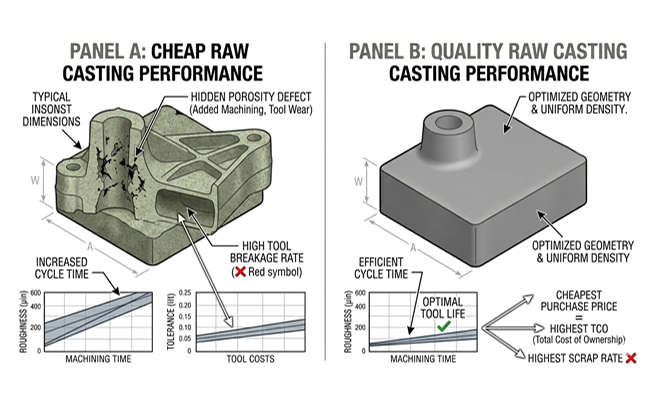
“I don’t need the premium casting,” I once told a quality manager, pointing to a tight project budget. “We have an experienced machining team; they can make any casting work. Let’s take the quote that’s 20% lower.” We took the deal. When the first pallet of 100 ‘cheap’ castings arrived, they looked acceptable to the naked eye. But once we mounted that first gray iron housing onto our vertical machining center, the visual on the left of this diagram became our new daily reality.
The raw castings were structurally flawed and dimensional nightmares. As our operator established the primary reference plane (G54), he realized the inconsistent surface required an extra, unexpected roughing pass. That added machining time alone erased any ‘purchasing’ savings (Image reference: ‘INCREASED CYCLE TIME’ callout). Worse still, within a week, he broke two expensive carbide endmills. We sectioned a scrap part to find severe internal porosity—hidden voids that acted like internal sand traps, instantly dulling and shattering tools (Image reference: ‘HIDDEN POROSITY DEFECT’ callout, referencing image_1.png and image_9.png logic). Our scrap rate skyrocketed from 1% to 15%.
When we ran the final numbers, the TCO for the ‘cheap’ casting was 30% higher than if we had just paid for the quality ones upfront (Image reference: TCO bar graph comparison). The ‘quality’ casting performance shown on the right is what robust, repeatable production looks like. We should have listened to our own advice on uniform wall thickness optimization from image_1.png and image_9.png: a uniform density from a known foundry optimizes tool life and secures repeatable, profitable production.