Green Sand Casting vs. No-Bake: A Comparative Guide to Surface Finish and Tolerance

Why We Are Specialized in Inconel 718 and the Challenges We Overcame
2026-09-21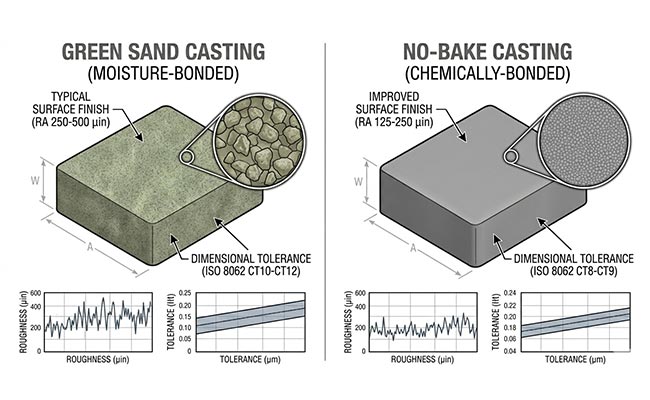
In my engineering journey, I’ve often had to choose between speed and smoothness, and that tension is perfectly encapsulated when deciding between Green Sand and No-Bake casting methods. For those just starting out, Green Sand is the absolute workhorse—quick, incredibly cost-effective, and using simple moisture-bonded sand. But early on, I learned that cost savings come at a price in the final component’s look and feel.
If you are aiming for tight dimensional tolerances, as visualized in this comparative diagram, Green Sand is challenging. Look at the rough, irregular grains on the left, labeled ‘RA 250-500 µin.’ That surface texture is a direct result of how the moist sand packs. While it’s fine for non-critical structural parts, any face needing a precise machine interface or a cosmetic finish will require heavy post-processing.
No-Bake, on the other hand, is what I use when I need things right. It uses chemically-bonded sands, and the difference, as seen on the right, is night and day. With a vastly smoother microscopic structure—labeled ‘RA 125-250 µin’—I get much better as-cast finishes, reducing machining. But more critically, I use No-Bake for its stability. The rigid mold allows me to regularly achieve much tighter dimensional tolerances (CT8-CT9) compared to Green Sand (CT10-CT12).
For me, the choice isn’t about which method is better; it’s about matching the visualization of the final component with the realistic capability of the process. If you can accept a CT10-CT12 tolerance, go with Green Sand and pocket the savings. But if you need to hit CT8 tolerances repeatedly, you have to embrace the precision of No-Bake.