Selecting the Right Aluminum Alloy for Marine vs. Aerospace Applications

Gray Iron vs. Ductile Iron: When to Choose Which for Optimal Performance
2026-08-31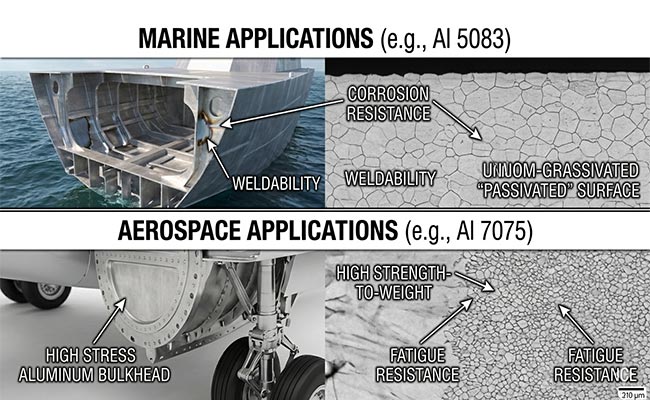
In my engineering career, I have often had to wear two hats: one that resists corrosion and one that defies gravity. Aluminum alloys are my preferred materials for both, but knowing which hat to put on when is the secret to success, as this visualization of Marine vs. Aerospace applications shows.
When I’m designing for a salt-water environment—something like a heavy-duty workboat hull, as seen at the top—I don’t just think about strength; I think about survival. Aluminum 5083, sometimes 6061, is my ‘go-to.’ Its grain structure, as magnified, is designed to be highly uniform and form a passive, corrosion-resistant surface. This is the material that won’t pit, scale, or fail under years of constant saltwater exposure. Plus, I need that specific grain structure because it makes the material highly weldable—critical for building massive, watertight structures. I once specified 7075 for a marine application, and let’s just say, lesson learned. The corrosion was rapid, catastrophic, and expensive.
Now, when I’m designing an aerospace part—something like a high-stress bulkhead or a landing gear component, shown at the bottom—my entire perspective changes. Weight is my enemy, and strength is my ally. Here, Aluminum 7075, or sometimes 2024, is my material of choice. Its micro-structure, visualized on the bottom right, is ultra-fine and grain-refined, which gives it immense tensile strength and fatigue resistance—essential for a part that might see a life of millions of complex, fluctuating loads. It is a material that, despite its impressive strength-to-weight ratio, is not meant for corrosion resistance and is difficult to weld.
It’s about knowing the trade-offs, matching the specific, magnified material traits to the environmental demands, and being clear about what ‘optimal performance’ really means for that specific application.