When to Upgrade from Sand Casting to Investment Casting for Precision Components

Green Sand Casting vs. No-Bake: A Comparative Guide to Surface Finish and Tolerance
2026-09-28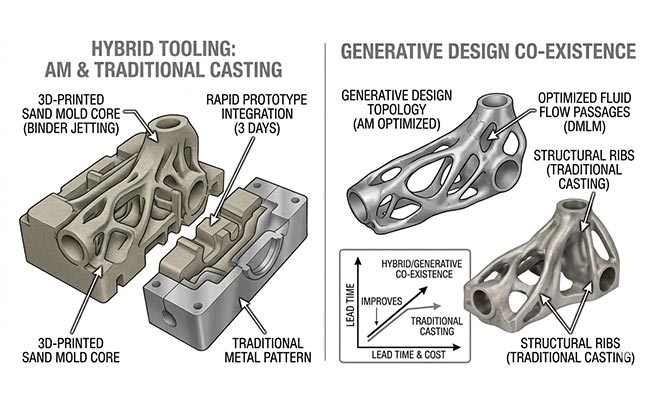
Early in my career, I was always trying to push the boundaries of sand casting. I was determined to make it work, but the process limits are real, as this diagram perfectly illustrates. If you find yourself repeatedly designing complex components with fine features—like those intricate internal passages or deep blind holes visualized in the top panel—sand casting will fight you at every turn.
The top panel, ‘STANDARD SAND CASTING PRECISION,’ shows the reality of designing for rough tolerance. Look at that blind hole labeled ‘ROUGH TOLERANCE: BLIND HOLE (±0.5mm).’ To make that feature reliably in sand casting, you have to design for ±0.5mm tolerance. If your assembly needs better than that, you must accept a bulky, oval-looking hole that requires heavy, secondary drilling and reaming. It is a costly way to achieve precision.
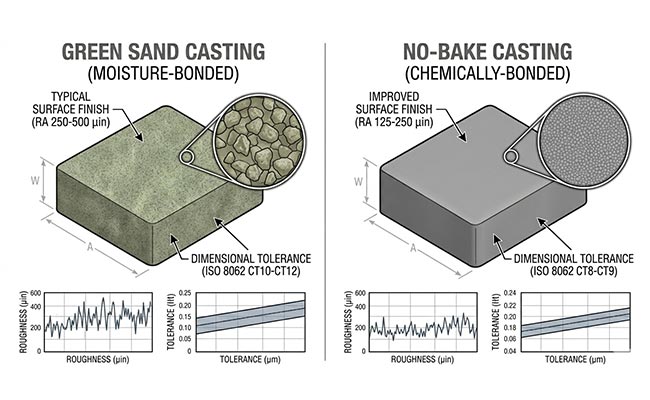
That is where I upgrade to investment casting. The bottom panel, ‘INVESTMENT CASTING PRECISION (UPGRADE),’ shows the identical geometry but visualized with flawsless smoothness, referencing the visual quality of No-Bake, as seen in image_14.png. Look at that identical blind hole: now perfectly circular and hitting ±0.05mm. By switching to a ceramic shell, I can hold tolerances ten times tighter than sand.
For me, the key decision point is realizing that you can’t just machine precision into a rough casting; you must choose a process capable of holding it. Investment casting lets me regularily achieve sharp fine thread profiles and maintain the tight CT7-CT8 tolerance ranges needed for high-performance components, which is a repeated, profitable production process that I can stand behind.