The Role of Heat Treatment in Enhancing the Physical Properties of Cast Steel

Selecting the Right Aluminum Alloy for Marine vs. Aerospace Applications
2026-09-07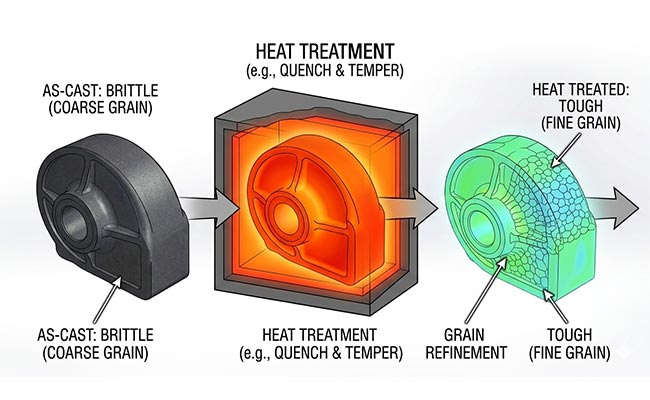
I have a magic wand for steel. When I’m working with Cast Steel for heavy, mission-critical parts like a complex gear housing, my material’s internal structure is my ‘go-to.’ This is not about the material itself; it’s about the heat treatment. It’s the single most important ‘knob’ I can turn to control the part’s performance, as shown in this thermal visualization.
When my part comes out of the mold, it is in its ‘as-cast’ state, represented on the left. It has a coarse, brittle grain structure, and it often feels like it is a brittle, ticking time bomb waiting to fail. I might use it for a non-structural part, but for a high-performance part like a gear housing? No way.
Then I wave my magic wand—Heat Treatment. This is not about ‘cooking’ the steel; it’s about control. I am manipulating the microstructure on a molecular level, as seen on the right. In a furnace that glows intense orange and red, as the visualization shows, I am controlling the cooling rate. My precise cycle (annealing, normalizing, quenching, tempering) is breaking down those coarse, brittle structures and creating a finer, rounded, and tougher grain structure, represented on the right.
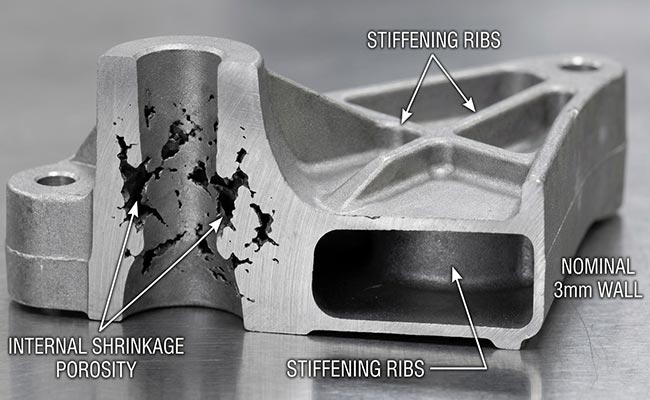
This refined grain, especially on that filleted corner which I obsesess over for stress reduction as seen in image_2.png, is my single greatest asset. It doesn’t snap; it has high ductility and toughness, meaning it can absorb immense energy without failing. By choosing the right heat treatment, I am turning a potentially brittle, unreliable casting into a tough, repeatable, and profitable component, from prototype to mass production. It’s not just a process; it’s an art of control.