Additive Manufacturing vs. Traditional Casting: Can They Co-Exist?

When to Upgrade from Sand Casting to Investment Casting for Precision Components
2026-10-12
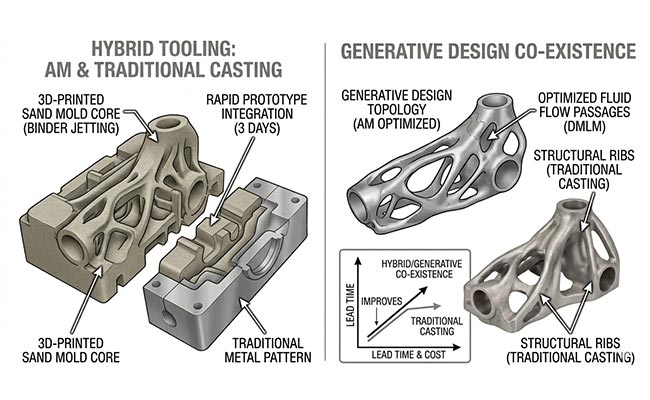
I often get asked if 3D printing will replace casting. My answer is, “No, it is going to make casting better.” The tension between additive manufacturing (AM) and traditional methods is real, but early on, I learned to see AM not as a threat but as a powerful new tool in my manufacturing toolkit. The real opportunity, as this dense, technical diagram perfectly captures, is not substitution but co-existence.
The diagram visualizes two powerful ways these technologies are already collaborating. On the left, ‘HYBRID TOOLING: AM & TRADITIONAL CASTING,’ I see the future of rapid prototyping. In my workshop, I use AM (specifically, binder jet sand printing) to rapidly create complex internal sand cores. Instead of spending weeks on expensive hard tooling for a prototype pattern, I can print a core, as visualized with a grainy, matte texture, and integrate it directly into a traditional metal pattern mold halves. This ‘RAPID PROTOTYPE INTEGRATION (3 DAYS)’ is a total game-changer, slashing lead times for complex, low-volume components.
The right side, ‘GENERATIVE DESIGN CO-EXISTENCE,’ highlights an even more powerful synergy. Look at that complex metal component generated through topological optimization (the organic, bone-like structure). While AM (like DMLM) is perfect for printing those complex internal flow passages (CT7-CT8 tolerance, referencing image_15.png), traditional casting remains unrivaled for creating high-volume structural ribs and bulky mounts. I design components that use Generative Design Topology (AM Optimized) for the intricate features and Traditional Casting for the structural mass. For me, co-existence is not just a strategic decision; it’s a repeatable, profitable production process that uses the right tool for the right feature.