Gray Iron vs. Ductile Iron: When to Choose Which for Optimal Performance

Why I Obsess Over Fillets and Radii: My Secret to Reducing Stress Concentration
2026-08-24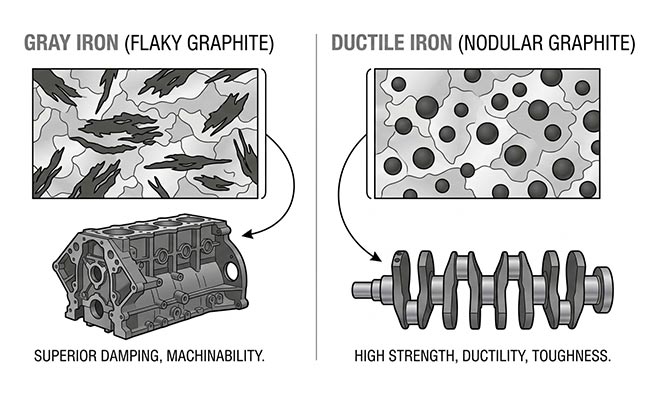
I often tell my students, “Cast iron is like a box of chocolates; you have to know which type you are biting into.” In the engineering workshop, that decision usually comes down to two main contenders: Gray Iron and Ductile Iron. Both are fantastic materials, but their micro-structures, as you can see in the visualization, determine their radically different behaviors.
When I am designing something like a heavy machine base or an engine block, I always lean toward Gray Iron. Why? Look at those graphite flakes. They act like tiny internal friction buffers, which gives Gray Iron unmatched damping capability. It naturally absorbs vibrations that would shake another material apart. Plus, those same flakes make it incredibly easy to machine, meaning I can hit precise tolerances quickly and cheaply. It’s the material that stays quiet and does the heavy lifting, even if it is inherently brittle and doesn’t bend well.
However, when my design calls for strength and a bit of flex—something like a crankshaft or a heavy-duty bracket—Gray Iron just won’t cut it. That is where I switch to Ductile Iron. Its graphite is formed into nodules or spheres, as shown on the right of the diagram. These nodules act like ‘internal shock absorbers,’ preventing cracks from propagating through the material. This structure gives it immense tensile strength and ductility—the ability to deform under load without snapping. When I have high-stress or impact loads, Ductile Iron is my ‘go-to’ because I know it will hang tough when Gray Iron would crack under pressure.
Choosing between them is less about one being ‘better’ than the other, and entirely about matching the material’s structural personality to the dynamic needs of the application.