Why I Obsess Over Fillets and Radii: My Secret to Reducing Stress Concentration

Optimizing Wall Thickness in Aluminum A380 for Flow, Strength, and Weight Reduction
2026-08-18
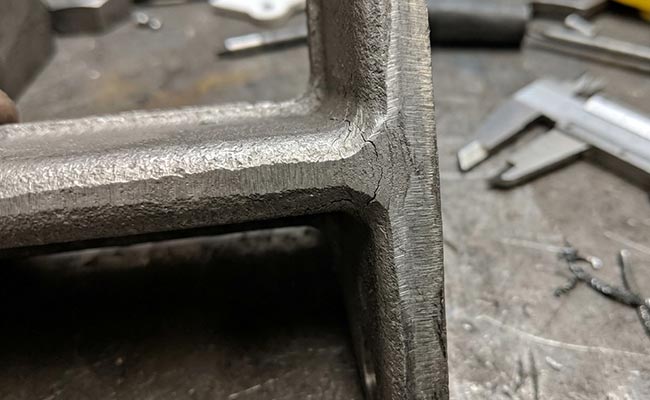
I have a absolute pet peeve when I review other people’s CAD designs: sharp internal corners. I don’t just see them as sloppy modeling; I see them as tiny ticking time bombs waiting to ruin a design’s fatigue life or cause a component to fail under a simple static load. In engineering, these sharp, $90^{\circ}$ transitions are known as “stress raisers,” and they are the absolute enemy of structural integrity.
When a cast part is put under load, the stress within the material doesn’t distribute itself evenly. It bunches up where the geometry changes abruptly. Think of it like a funnel, forcing the total “flow” of stress into a very narrow area.
The Math of Stress Concentration
The intensity of this effect is measured by the stress concentration factor ($K_t$). It is a pure multiplier. If a simple load creates $100\text{ MPa}$ of average stress in a uniform beam, that same load can generate $400\text{ MPa}$ of peak stress at a sharp internal corner, where $K_t$ can be $4.0$ or higher. This peak stress is often where fatigue cracks first initiate, leading to a fatigue failure far below the ultimate tensile strength.
My secret weapon against $K_t$ is the generous use of fillets (rounded internal corners) and radii (rounded external edges). I obsesses over giving those stress lines a smooth, gentle curve to follow.
Four Critical Reasons to Add Fillets
Beyond reducing stress, I’ve found that the manufacturing and functional arguments for adding fillets are equally powerful.
Lower Peak Stress: This is the primary driver. Even a small fillet radius ($r$) can dramatically reduce peak stress. By increasing $r$ from $0.5\text{ mm}$ to $2.0\text{ mm}$ in a $10\text{ mm}$ wall, I can often cut the peak stress at that corner by 50%.
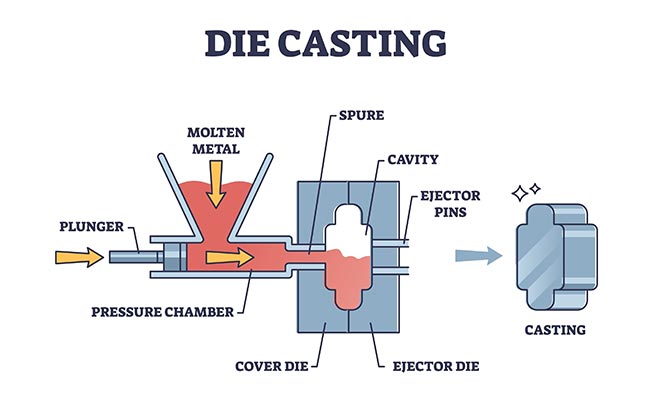
Extended Die and Tool Life: Sharp internal corners in a casting mold are classic locations for “heat checking.” Thermal shock from molten metal causes tiny fatigue cracks in the tool steel, which eventually requires expensive repair or replacement. Rounding your mold-side corners (which become part internal fillets) significantly extends the life of a $100,000 tool.
Improved Fluid and Molten Flow: Whether it’s molten aluminum filling a mold or hydraulic fluid moving through a passage, fluid hates sharp $90^{\circ}$ turns. They cause turbulence and “recirculation zones,” which trap air and cause imperfections like gas porosity. Filleted passages encourage a smooth, low-turbulence flow during casting and operation.
Finish and Usability: Sharp external corners are a safety hazard to assembly workers and a nightmare for painters. Paint has a hard time clinging to a sharp edge. A small outside radius improves safety, makes the part feel better to handle, and allows for a more durable, premium finish.
Summary
I treat every internal corner as an opportunity to add strength. A $1.0\text{ mm}$ or $2.0\text{ mm}$ fillet may seem like a minor detail, but it’s often the single most impactful design feature you can implement to dramatically extend the fatigue life of your final product.