Beyond the Pour: The Art and Science of a Modern Casting Foundry

Corrosion-Resistant Castings for Marine Environments: Choosing the Right Alloys
2026-06-22
Using Green Sand and Other Sustainable Molding Materials in Steel Casting
2026-07-06Stepping into a casting foundry might evoke images of molten metal and ancient craftsmanship. While the fundamental principles of pouring liquid metal into a mold remain, a modern casting foundry is a vibrant blend of time-honored skill, cutting-edge technology, and rigorous scientific precision. We don’t just “make” parts; we engineer them.
At our facility, we pride ourselves on pushing the boundaries of what’s possible with cast metals. Let’s take a look at what makes a contemporary casting foundry thrive.
The Heartbeat of Production: Precision Pouring
The moment of the pour is undoubtedly the most dramatic and critical phase in the casting process. It requires immense control, not just over the molten metal’s temperature but also its flow rate and consistency. In modern foundries, this isn’t left to chance.
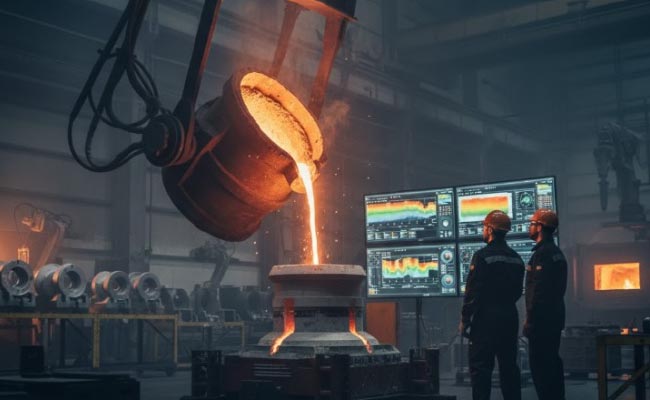
Advanced Induction Furnaces: We utilize induction furnaces that provide precise temperature control, allowing us to melt specific alloys to their exact superheat requirements, ensuring optimal fluidity and metallurgical integrity.
Automated Pouring Systems: For many applications, automated pouring systems ensure a consistent and repeatable pour, minimizing human error and enhancing safety. Sensors continuously monitor the pour, adjusting variables to prevent defects like misruns or gas entrapment.
Metallurgical Analysis: Before and after the pour, samples of the molten metal are quickly analyzed using spectrometers. This ensures the chemical composition is precisely within specification, guaranteeing the final part’s mechanical properties.
The Unseen Power: Simulation and Design
Long before the metal is melted, the success of a casting is often determined in the digital realm. Modern foundries leverage powerful simulation software to predict and prevent defects, optimize designs, and streamline production.
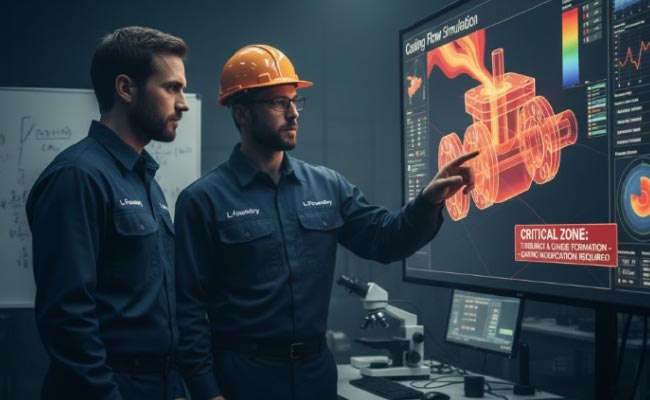
Simulation Software at Work: * Flow Simulation: We model how molten metal will fill the mold cavity, identifying potential turbulence, cold shuts, or air entrapment. This allows us to optimize gating and runner systems for a smooth, complete fill. * Solidification Analysis: Thermal imaging simulations predict how the casting will cool and solidify. This helps us precisely place risers to compensate for shrinkage and avoid porosity, ensuring a dense, defect-free internal structure. * Stress Analysis: We can even simulate the stresses that develop during cooling to predict and prevent hot tears or warping, especially in complex geometries.
More Than Just Metal: A Commitment to Quality
A modern casting foundry is more than just a place where metal parts are made. It’s an environment where innovation meets precision, where engineers work hand-in-hand with skilled technicians, and where every step, from alloy selection to final inspection, is meticulously controlled. This commitment ensures that every casting leaving our factory isn’t just a component, but a promise of quality and performance.