Corrosion-Resistant Castings for Marine Environments: Choosing the Right Alloys

Understanding Tolerances: What Precision Can You Realistically Expect?
2026-06-15
Beyond the Pour: The Art and Science of a Modern Casting Foundry
2026-06-29When metal meets the ocean, the battle begins instantly. Saltwater is a high-conductivity electrolyte that accelerates electrochemical reactions, leading to pitting, crevice corrosion, and biofouling. In a casting factory, selecting the right alloy isn’t just about strength—it’s about ensuring a part doesn’t dissolve or fail prematurely under the relentless attack of chloride ions.
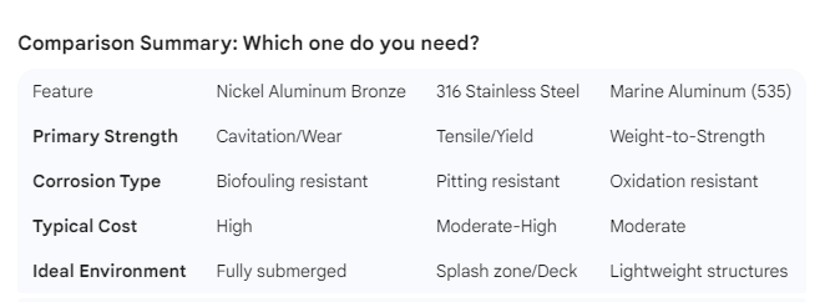
Choosing the wrong alloy for a marine environment is an expensive mistake. Here is a guide to the three heavyweight contenders in marine casting and how to choose between them.
1. Nickel Aluminum Bronze (NAB): The Propeller King
Best for: Propellers, pump impellers, and underwater valves.
Nickel Aluminum Bronze (specifically alloys like C95800 or C95500) is widely considered the “gold standard” for submerged marine castings. It forms a complex, self-healing protective film composed primarily of aluminum and cuprous oxides.
Why it wins: It offers exceptional resistance to cavitation (pitting caused by high-speed water bubbles) and biofouling. Barnacles and algae find it difficult to attach to copper-based surfaces.
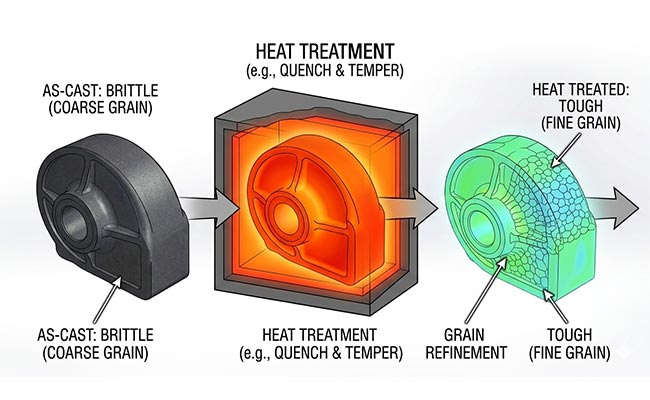
The Metallurgy: The addition of nickel and iron refines the grain structure, providing tensile strength comparable to medium-carbon steels.
2. Stainless Steel (Grade 316 and Duplex): The Structural Heavyweight
Best for: Deck hardware, fasteners, and structural housings.
While standard 304 stainless steel will “tea-stain” and pit in hours of saltwater exposure, 316 Stainless Steel contains 2–3% molybdenum, which drastically improves its resistance to chlorides. For even more extreme loads, Duplex Stainless Steel (like 2205) offers double the strength and even higher corrosion resistance.
The Risk: Stainless steel relies on a “passive” oxide layer that needs oxygen to survive. In tight crevices where water is stagnant (crevice corrosion), this layer can break down.
Best Practice: Always specify 316L (low carbon) if the cast part requires welding, as this prevents “intergranular corrosion” near the weld seams.
3. Marine-Grade Aluminum (A356 and 535): The Lightweight Alternative
Best for: Outboard motor housings, boat hulls, and shipyard infrastructure.
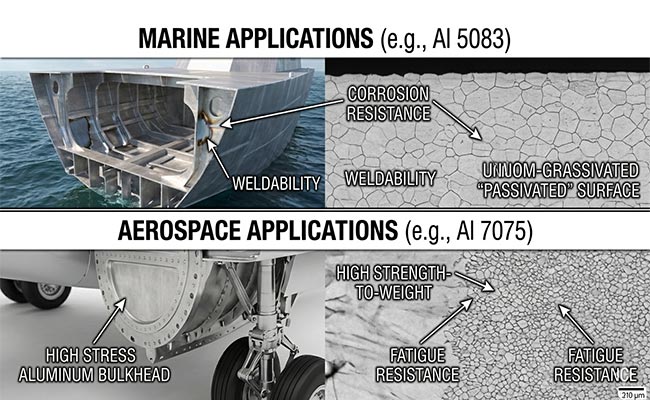
Aluminum is the go-to for weight reduction. However, you must avoid “general-purpose” alloys with high copper content (like A380), as copper acts as an internal battery in saltwater, causing the aluminum to corrode from the inside out.
The Top Pick: Alloy 535 (Almag 35) is a magnesium-aluminum alloy specifically designed for marine use. It offers the highest corrosion resistance of any cast aluminum alloy and provides a beautiful finish when anodized.
The Runner Up: A356 is the industry workhorse. While slightly less resistant than 535, its excellent fluidity makes it the best choice for complex, thin-walled marine housings.