Why Do Castings Fail?

Why Do Castings Fail? Understanding and Preventing Common Defects
2026-06-01
Understanding Tolerances: What Precision Can You Realistically Expect?
2026-06-153. Hot Tears & Cracks: Stress During Cooling
These defects are typically linear fractures that occur during the solidification and cooling process.
Hot Tear: Occurs when the casting is still very hot and ductile, but constrained by the mold or core, leading to internal stresses that pull the metal apart.
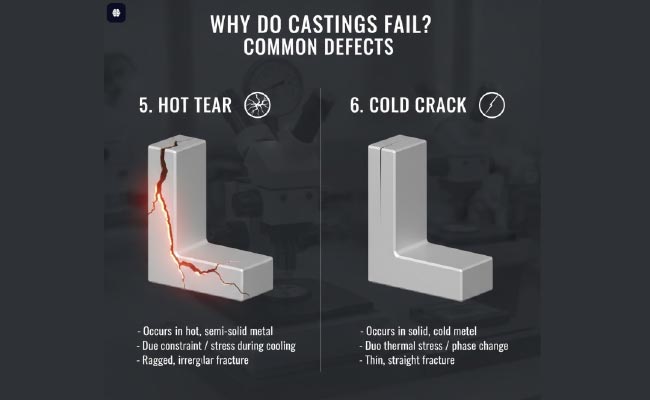
Cold Crack: Forms after the casting has completely solidified and cooled to lower temperatures, often due to excessive thermal stresses or stresses induced by phase transformations within the metal.
How We Prevent Hot Tears and Cold Cracks:
Design for Manufacturability (DFM): We work closely with clients to optimize part designs, eliminating sharp corners, abrupt section changes, and large unconstrained areas that can concentrate stress during cooling.
Controlled Cooling: Our foundries utilize controlled cooling rates and careful knockout procedures to minimize thermal shock and allow the casting to cool uniformly, relieving internal stresses.
Mold Collapsibility: For sand molds, we ensure the sand mixture has appropriate collapsibility to yield as the casting shrinks, preventing it from tearing itself apart.
4. Inclusions: Unwanted Foreign Matter
Inclusions are non-metallic particles entrapped within the metal matrix. These can be oxides from the molten metal, slag, refractory materials from the furnace or ladle, or even sand from the mold.
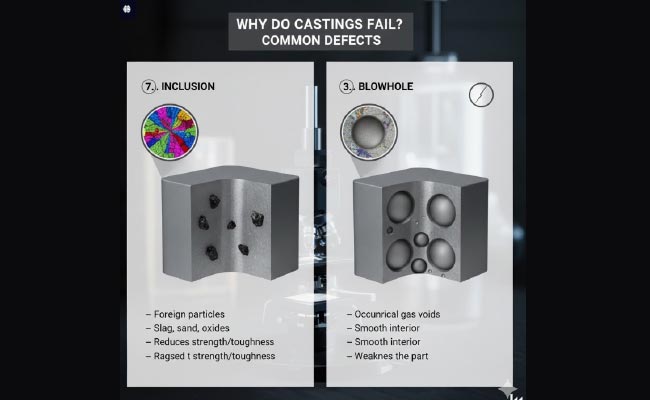
Inclusions act as stress concentrators, reducing the casting’s strength, ductility, and fatigue life. They can also lead to machining difficulties.
How We Prevent Inclusions:
Metal Cleanliness: We employ rigorous melting practices, including fluxing and skimming, to remove slag and impurities from the molten metal.
Filtration: Ceramic filters are often placed in the gating system to physically remove non-metallic inclusions before the metal enters the mold cavity.
Refractory Quality: We use high-quality refractory materials for furnaces and ladles that resist erosion and spalling, preventing them from contaminating the melt.
Conclusion: Engineering for Perfection
Casting defects are not inevitable. They are symptoms of uncontrolled variables in the casting process. At our factory, preventing these failures is not an afterthought; it’s integrated into every stage of our operations. From advanced metallurgical analysis and simulation-driven design to meticulous process control and rigorous quality inspection, we are committed to delivering castings that meet the highest standards of integrity and performance.
By understanding the “why” behind potential failures, we can confidently engineer the “how” to prevent them, ensuring your components are not just cast, but crafted for excellence.