The most common production challenges in the foundry industry.

Minimizing Environmental Impact in Foundry Operations
2026-07-13
Lightweight casting solutions for the automotive sector
2026-07-27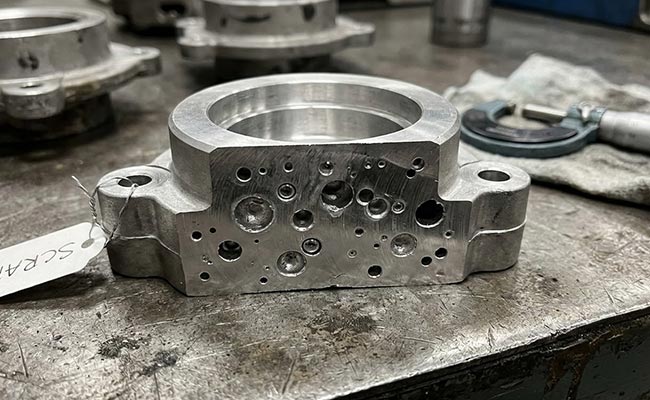
In the foundry world, we don’t just fight the clock; we fight physics, chemistry, and sometimes just plain bad luck. Here are the production hurdles that keep me up at night—and keep the scrap bin full.
1. The Invisible Enemy: Gas Porosity
Nothing ruins my morning quite like machining a beautiful casting only to find it looks like Swiss cheese inside. Gas porosity is the bane of my existence.
Liquid metal is like a sponge for hydrogen. As the metal cools and solidifies, the solubility of gas drops significantly, forcing the gas out of the solution and creating tiny bubbles (voids). We often look at Sievert’s Law to understand this relationship between pressure and gas concentration:
$$[H] = k \sqrt{P_{H_2}}$$
If the mold is damp or the melt isn’t degassed properly, you’re basically pouring a carbonated soda made of aluminum. It’s a constant battle of moisture control and chemical fluxing.
2. Shrinkage: The “Hollow” Reality
Metal shrinks as it transitions from liquid to solid. It’s a simple fact, but managing it is an art form. If I don’t design the “risers” (those extra reservoirs of metal) correctly, the casting will pull material from its own center as it cools, leaving a nasty internal cavity.
I’ve spent more hours than I care to admit recalculating cooling rates and moving gates around just to ensure the “hot spots” don’t end up in the critical dimensions of the part.
3. The “Sand” Variable
In sand casting, your mold is only as good as your mix. If the sand is too dry, the mold collapses. If it’s too wet, you get a steam explosion (which is exactly as terrifying as it sounds).
The Foundry Reality Check
| Challenge | What we want | What actually happens |
| Dimensional Accuracy | Parts that match the drawing to the millimeter. | Thermal expansion makes the metal “grow” and “shrink” in ways that defy logic. |
| Surface Finish | Smooth, “jewelry-like” textures. | The sand reacts with the metal, leaving a “burnt-on” crust that takes hours to grind off. |
| Melt Purity | Clean, alloy-perfect metal. | A stray piece of painted scrap gets in the pot and ruins the entire chemistry. |
4. The Labor & Skills Gap
I can buy the fanciest induction furnace on the market, but it’s useless without someone who knows how to “read” the melt. We are facing a massive shortage of people who actually want to do this work.
It’s hot, it’s heavy, and it requires a high level of technical literacy. Finding a technician who understands both the metallurgy of grain structures and how to operate a robotic grinding arm is like finding a needle in a haystack.
5. Energy Costs and Sustainability
Keeping a furnace at 1,500°C isn’t cheap. With energy prices fluctuating, my production margins can vanish in a single afternoon. Plus, there’s the constant pressure to reduce our carbon footprint. Moving toward “Green Foundry” practices—like recycling 98% of our sand and using electric infrared ladles—is a massive logistical mountain to climb.
Despite all the headaches, there’s still nothing quite like the feeling of a “clean hit”—when the mold breaks away and the part is perfect. It makes all the scrapped pours and singed eyebrows worth it.