What is “Draft” and Why Your Casting Design Absolutely Needs It

Beyond the Blueprint: How to Design for Manufacturability (DfM) cont
2026-04-27
The Critical “Why”: Why Your Casting Design Absolutely Needs Draft
2026-05-11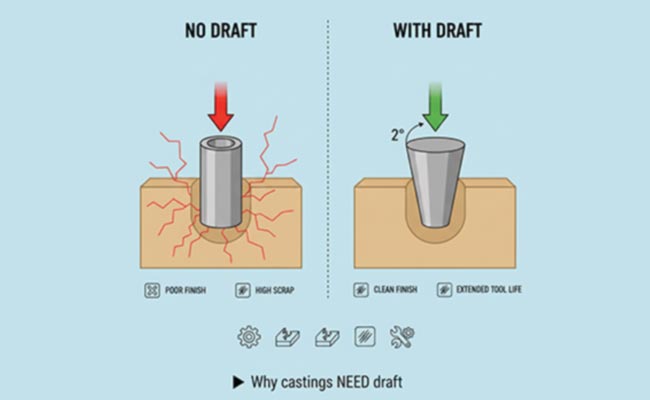
When designing a part for metal casting, many engineers focus on critical dimensions, material properties, and structural integrity. All of these are vital, but there’s one often-overlooked feature that can make or break the manufacturability and cost-efficiency of your cast component: draft.
If you’ve ever tried to pull a perfectly straight-sided object out of a tight mold, you’ve likely encountered the frustration of it getting stuck, scratching, or even breaking. That’s precisely why draft is so important.
What Exactly Is Draft in Casting?
Simply put, draft is a slight taper or angle applied to the vertical walls of a cast part or its pattern. Instead of a wall being perfectly perpendicular (90 degrees) to the parting line of the mold, it will be angled by a few degrees.
Imagine trying to remove a perfectly cylindrical carrot from a hole in a cutting board – it’s tough, right? Now imagine if the carrot was slightly conical, wider at the top. It would pop right out! That slight conical shape is analogous to draft.