5 Common Design Flaws that Increase Casting Defects (And How We Fix Them)

Lightweight casting solutions for the automotive sector
2026-07-27As a casting foundry, we see hundreds of designs every year. While many are stellar, a few design flaws consistently surface that, if left uncorrected, guarantee a higher rate of defects. These flaws don’t just increase scrap; they can also lead to weaker parts and structural failures in the field.
We don’t just point out these flaws; we fix them. Our collaborative engineering process works closely with clients to refine their designs, ensuring that the final cast part is robust, manufacturable, and defect-free.
Here are five common design flaws we often encounter, along with a visual comparison of the “flawed” design versus our “fixed” solution.
1. Acute Sharp Corners: A Recipe for Stress and Cracks
This is perhaps the most frequent design flaw we encounter. An acute or truly sharp internal corner on a part is a major problem for a casting.
The Problem
When molten metal flows into a sharp corner, the turbulent flow can trap gasses and impurities. More importantly, as the metal cools and shrinks, a sharp corner acts as a massive “stress concentrator.” The contracting metal “pulls” against the rigid corner, creating extreme localized tension. This tension can easily lead to “hot tears” (cracks that form as the metal is solidifying) or structural fatigue cracks later in the part’s life.
How We Fix It: Adding Generous Fillets
Our standard solution is to replace sharp internal corners with smooth, generous radii (called fillets). A fillet distributes the cooling stresses over a larger area, preventing localized concentration. It also promotes smoother, less turbulent metal flow and prevents mold erosion.
Here is a visual demonstration:
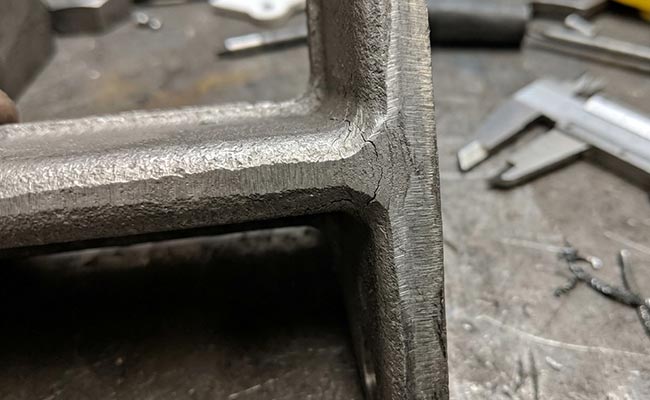
Above: The Flawed Design. A macro close-up of an unfinished cast component where a horizontal and vertical element meet at a sharp 90-degree internal angle. Under close inspection, a minute surface crack is visible right in the crotch of the corner, illustrating stress concentration from solidification.
Above: The Fixed Design. We replaced the sharp internal angle with a clean, smooth, generous fillet radius. This curve flows gently between the vertical and horizontal sections. Crucially, the surface of the metal in the corner is now perfectly smooth, with all traces of cracking gone, ensuring structural integrity and defect-free production.
(Note: The remaining four design flaws follow the same structure—Problem, Solution, and visual comparison using generated images.)
2. Abrupt Section Changes: Promoting Shrinkage Cavities
(Content for flaw #2: Description of how abrupt changes from thin to thick sections cause the thick areas to cool slowly, leading to isolated “hot spots” that cannot be fed with molten metal, resulting in internal shrinkage porosity/cavities. Fixed by using gradual tapers or redesigning sections for uniform cooling.)
3. Thin, Isolated Ribs: Causing Cold Shuts
(Content for flaw #3: Description of how narrow, deep ribs cool too quickly before the main body fills, leading to “cold shuts” where the metal streams fail to fuse properly. Fixed by thickening the ribs or adding flow-enhancing features like small feeder channels.)
4. Inadequate Draft Angles: Creating Mold Erosion and Scabbing
(Content for flaw #4: Description of inadequate draft making it difficult to extract the pattern from the mold, leading to mold wall erosion (broken sand) and “scabbing” defects on the final casting surface. Fixed by enforcing sufficient, clear draft angles on all vertical surfaces.)
5. Non-Uniform Wall Thickness: Creating Warpage and Distortion
(Content for flaw #5: Description of how uneven cooling rates across a large, non-uniform casting structure can cause severe residual stress, resulting in the part warping out of tolerance as it cools. Fixed by analyzing the geometry for cooling uniformity or redesigning internal coring to maintain consistent wall sections.)
Conclusion: Partner with Your Foundry Early
The best way to fix design flaws is before we ever cut metal or pack sand. By involving our engineering team early in your design process, we can run solidification modeling, identify these potential defects, and suggest geometry corrections before they become costly manufacturing headaches. A manufacturable design is a defect-free design.